What Is the Job of a Forward Deployment Engineer?
A forward deployment engineer is a software engineer who takes an unclear customer or business problem and turns it into working production software. The work usually starts before there is a clean ticket, stable data contract, finished product requirement, or agreed deployment plan. It ends when users can rely on the system in their actual workflow, not when a prototype looks good in a demo.
The role is hybrid by design: part engineer, part product strategist, and part field operator. Its real shape comes from five connected ideas: why the role exists, what it owns across the customer boundary, how field work becomes platform leverage, what the workflow looks like in practice, and where the job separates from software engineering, solutions work, implementation, and consulting.
The job in one sentence
The job of a forward deployment engineer is to embed near the user problem, identify the operational decision that matters, build the technical system that improves it, deploy that system into the real environment, and convert field learning into product or platform leverage.
Every phrase in that sentence matters.
Embed near the user problem means the FDE works close enough to see the real
workflow, not only the documented process.
Identify the operational decision means the FDE narrows the work to a
decision, action, exception, routing step, forecast, recommendation, or
control point that changes what people do.
Build the technical system means the FDE writes or directly shapes software,
data logic, integrations, model workflows, internal tools, or production
services.
Deploy into the real environment means identity, permissions, latency,
secrets, logging, monitoring, rollout, rollback, and support are part of the
job.
Convert field learning into leverage means the work should not remain a
private one-off workaround if the pattern can become product capability,
platform abstraction, deployment playbook, or reusable engineering knowledge.
Why this job exists
FDE exists because the hardest enterprise software problems do not stay inside one clean function.
Forward deployment engineering exists because important operational problems often break the normal separation between business analysis, data science, software engineering, cloud deployment, and product management.
In a clean delivery model, a business team writes requirements, a data team validates the data, an engineering team builds the system, a platform team deploys it, and users adopt it. In real organizations, that sequence often fractures.
The business requirement may be a symptom rather than the real decision. The system of record may be incomplete. The same metric may mean different things to different teams.
The user workflow may depend on undocumented spreadsheets, manual overrides, Slack messages, or exception handling that never appears in the process map. A prototype may work in a controlled environment and fail once it meets access control, latency, data freshness, model drift, or production support.
The FDE job exists at that fracture point. The role carries the problem across the layers until the system is useful under operating conditions.
The term forward deployed borrows from military language: assets are placed
close to the operational front so they can respond to what is happening on the
ground. In software, that means the engineer is close enough to the customer
environment to see the operating constraints directly instead of receiving them
through a chain of summaries.
That proximity also tightens the OODA loop. In a fast-moving domain, by the time a distant team finishes debating the old concept, tool, or architecture, the operating conditions may already have changed. An FDE moves forward into the new domain early, observes the shift while it is happening, orients the product around the new constraints, and turns that learning into a working path before the old plan becomes institutional momentum.
According to the 2026 preprint Forward Deployed Engineering: A Taxonomy and Definition, an FDE is not simply a customer-facing engineer. My read is that the paper frames the role as a product-company engineer placed close enough to the operating environment to adapt the technology in context, while still feeding what is learned in the field back into the product organization.
What tradeoff does FDE solve?
FDE solves the gap between scalable products and specific deployments.
It also exists because product companies face a hard tradeoff. Scalable products such as SaaS applications, APIs, and platforms cannot deeply customize for every client context.
Traditional consulting and systems integration can be highly specific, but each engagement is usually bespoke, expensive, and hard to compound. FDE is the attempt to keep enough specificity to solve the customer's real problem while preserving enough product alignment to make the next deployment faster.
This reframes customer work as product discovery from inside the enterprise, not sales-led requirements gathering from the outside. Done well, the model can compound product leverage and customer value over time. Done badly, it can collapse into pure services work: useful in the moment, but hard to repeat, maintain, or turn into stronger product capability.
Why does AI make FDE more important?
AI shifts the bottleneck from writing code to judging what should be built.
AI-driven development changes the economics of that tradeoff. As coding agents make implementation faster and cheaper, the bottleneck moves upstream and downstream.
The scarce work is defining the right problem, choosing the architecture, setting constraints, reviewing generated work, integrating with real systems, and verifying behavior in production.
In that environment, the FDE is valuable less because they can type every line by hand and more because they can decide what should be built, how it should be structured, and whether it actually works in the customer's operating context.
Why do LLMs create a deployment gap?
LLMs are general-purpose in capability, but deployment-specific in value.
That is why LLMs intensify the need for FDE-style work. They are general-purpose in capability but deployment-specific in value. A language model can theoretically perform many language tasks.
Making it reliably perform one enterprise task is different. That requires context engineering, private data access, tool integration, permission boundaries, evals, observability, and workflow design.
This creates the modern deployment gap. The technology can be more capable than ever while the distance between capability and deployed value also grows.
The limiting factor is not whether a model can answer in the abstract. It is whether the organization can turn that capability into a governed workflow, integrated system, trusted output, and measurable operating result.
What happens to agile delivery methods?
AI-assisted development makes review, architecture, and production readiness more important than raw implementation throughput.
Older agile practice valued working software over comprehensive documentation because getting useful software into users' hands was the central pressure point. AI coding agents change the failure mode. They can produce large amounts of plausible working code quickly.
That means the dangerous part is not only whether software exists. The dangerous part is whether the generated system has the right architecture, constraints, tests, integration boundaries, security posture, and production owner.
That shift changes how existing delivery methods behave. Scrum can still be useful, but its center of gravity moves.
If implementation becomes much faster, the sprint is less about estimating how much code a team can produce. It becomes more about whether the team chose the right problem, reviewed the architecture, and corrected course after seeing working software. Sprint review and retrospective become more important because that is where structure, outcome, and learning are tested.
Kanban fits the AI-assisted pattern more naturally when the work is uneven. Code generation may be fast, while problem framing, architecture review, security review, eval design, and production verification take variable time.
In that world, the bottleneck column often moves away from in development
and toward architecture review, integration review, or production
readiness.
How is the deployment target changing?
FDE is moving up the stack: from product deployment, to model deployment, to methodology deployment.
The deployment target is also becoming more abstract. Early FDE work often deployed a concrete product or platform into a customer environment. AI-era FDE work may deploy a general-purpose model into a specific workflow. The next layer is methodological: changing how teams build, review, evaluate, and operate software with AI agents in the loop.
That pattern resembles the layered modular architecture described in digital innovation research, where digital systems separate into loosely coupled layers such as devices, networks, services, and content.
According to Yoo, Henfridsson, and Lyytinen's 2010 paper The New Organizing Logic of Digital Innovation, digital innovation tends to organize around loosely coupled layers rather than one fixed product boundary. My read is that this helps explain why FDE work moves upward over time: the deployment target becomes the model, workflow, and operating method around the product, not only the product itself.
FDE has a similar upward movement: from product deployment, to model deployment, to deployment of a new way of working across the technology stack.
What the FDE actually owns
The FDE owns the path from problem ambiguity to production outcome.
The difference from a normal software role is the amount of ownership at the boundary. A regular engineer may receive a scoped feature. An FDE often has to find the real requirement, prove the data is usable, build the service or tool, deploy it, support adoption, and feed the pattern back into the product.
In the stricter taxonomy, the FDE is employed by the product company. That matters because the role can influence the roadmap, build on the company's existing platform, and stay aligned to product adoption and customer outcomes instead of billable hours.
That ownership includes:
- the decision or workflow the system must improve
- the data contract the system depends on
- the software or model path that encodes the logic
- the integration surface where the output enters the user's work
- the deployment environment where the system runs
- the observability needed to know whether the system is healthy
- the adoption path that determines whether users trust it
- the feedback loop that turns field learning into reusable capability
The job is not finished when the analysis is correct. It is not finished when the prototype runs. It is not finished when the code merges. It is not even finished at first deployment if nobody trusts, owns, monitors, or supports the system.
The job is finished when the business workflow, data logic, software path, deployment environment, and support owner hold together under real use.
Echo, Delta, and the gravel road
Robust FDE operating models often separate two field muscles.
The Echo role, sometimes called a deployment strategist, owns domain sense, stakeholder alignment, executive sponsorship, and the first use case that matters enough to change behavior. The best Echo is not just a relationship manager. It is someone close enough to the industry to understand how work is done today and sharp enough to explain why the current state is broken.
The Delta role is the forward deployed engineer. Delta work is the technical build path: rapid prototyping, integration, deployment, debugging, and iteration in front of users. The Delta builds the gravel road, which is the first rough but correct path that proves the outcome under real constraints.
Headquarters then has a different job. Core product and platform teams should study the gravel road, extract the reusable pattern, and pave it into a maintainable capability that can serve the next group of customers with less custom effort.
According to the 2026 Alvarez & Marsal report The Rise and Role of the Forward Deployed Engineer, the durable part of the model is not the first bespoke build, but the loop that converts field learning into repeatable platform capability. My read is that this is the line between FDE and consulting: the field team can prove the path, but the product organization has to make that path reusable.
If headquarters does not do that work, the field model becomes services. If headquarters paves too early, before enough field variation is understood, the platform can overfit to one customer's workflow.
Platform discipline, not services drift
The FDE model only compounds when product discipline sits above field speed.
That means the company has to generalize one level up. A field solution should not remain a feature for one customer if the underlying pattern can become a connector, workflow primitive, permission model, admin tool, evaluation harness, deployment template, or observability surface.
The platform also has to treat the FDE as a first-class user. The real measure is not whether one Delta team can heroically solve one deployment. The measure is whether the platform increases how much customer value one field team can deliver per unit of time and headcount.
This is where platform leverage shows up. The FDE should pull together as much as possible from existing product primitives, then write the domain-specific integration or workflow layer that the platform does not yet cover. If every deployment starts from scratch, the company is not compounding.
A useful product rhythm is demo-driven and outcome-backed. Rehearsal demos force the product to cohere around the user's path, while outcome evidence keeps the field and headquarters teams honest about whether the system created real value.
The field-to-core forum should be deliberate. Pulling multiple FDEs from different customer sites into the same product design conversation surfaces variation early and prevents the platform from hardening around a single workflow.
What to measure
FDE work should be measured by outcomes, not installs or seat counts.
Three metrics matter most:
- outcome value delivered, such as cycle-time reduction, cases processed, calls handled, dollars recovered, or another customer-validated impact
- contract size and expansion, which shows whether the work is becoming more valuable as proof accumulates
- product leverage on outcome, which shows how much value each FDE team can deliver and how quickly the same outcome can be repeated at another customer
Early deployments may look inefficient if measured account by account. That is not automatically a failure. It becomes a failure when the same custom work has to be repeated forever. If outcome value rises and the time to repeat the outcome falls, the model is turning field work into software leverage.
Where the model breaks
The common failure is perpetual bespoke work. The fix is to make repeatability a product KPI: how long does it take to deliver the same outcome at a new account, and how much configuration is needed before new code is required?
Another failure is IT friction that kills momentum. FDE teams need executive sponsorship, clear data-access authority, and a practical path through security, procurement, and on-premises integration constraints. Without that air cover, the field team can spend more time negotiating access than proving value.
A third failure is headquarters shipping abstractions that field teams will not use. Core engineers should spend time in the field, and a platform feature should not be considered paved until more than one independent field team can use it successfully.
The final failure is solving the sponsor's easy problem instead of the business's valuable problem. Echo teams should validate scope with operators and the profit-and-loss owner, not only the loudest stakeholder in the room.
The operating workflow
The FDE workflow is a control loop, not a waterfall.
The first move is problem framing. The FDE identifies the user, action, system, timing, constraint, and consequence. A weak request says, "build a dashboard." A stronger engineering requirement says, "show the warehouse planner which capacity exception needs action before the shift is locked." The second sentence can be built against because the owner, workflow, time window, and failure cost are visible.
The second move is workflow discovery. The FDE maps the triggering event, systems of record, handoffs, manual checks, exception paths, approvals, and final decision. This step separates the process people describe from the process they actually follow under pressure.
The third move is data interrogation. The FDE tests freshness, joins, identifiers, null behavior, lineage, duplication, metric definitions, schema drift, and hidden manual correction. A table can be queryable and still be unsafe for production logic.
The fourth move is solution scoping. The FDE chooses the smallest production path that can change the workflow without creating hidden debt. The answer may be a pipeline, API, internal tool, workflow integration, model-backed service, agent workflow, or small full-stack application.
The fifth move is implementation. The FDE builds where the workflow needs leverage. If trust is the problem, the build may need explanation and lineage. If handoff delay is the problem, the build may need routing and integration. If operational overload is the problem, the build may need prioritization, alerting, and exception handling rather than another passive dashboard.
The sixth move is deployment. The FDE gets the system into the real environment with authentication, authorization, secrets, network access, configuration, monitoring, rollback, and support expectations handled properly.
The seventh move is production learning. The FDE watches usage, support tickets, incidents, false positives, false negatives, latency, manual overrides, user trust, and data quality. These signals decide whether the system should be hardened, changed, generalized, or retired.
Day-to-day responsibilities
The day-to-day work looks fragmented because the blocker moves.
On one day, the FDE may clarify a business rule with an operations lead, discover that two systems use incompatible identifiers, and write integration code to move a decision into the user's workflow. On another day, the same FDE may debug a permission issue, review logs, adjust a rollout, or explain a model limitation to stakeholders who need to trust the output.
The responsibilities usually fall into six work modes.
Field discovery
Field discovery means working close enough to the customer or business team to understand what actually happens. The FDE identifies the real user, the real decision, the real workaround, the real exception path, and the real consequence of failure.
This mode requires interviews, observation, workflow mapping, ticket reading, system tracing, and the ability to convert vague language into requirements that engineers can build and test.
Data and system diagnosis
Data diagnosis means proving whether the system can rely on the available data. The FDE checks source systems, joins, freshness, identity resolution, lineage, data quality, metric definitions, event timing, and edge cases.
This mode prevents bad automation. If the data contract is weak, the software will only move broken business logic faster.
Product and solution shaping
Solution shaping means deciding what should be built, what should not be built, and what should become reusable. The FDE balances customer specificity against product leverage.
This mode requires judgment. Some work should be a custom deployment. Some should become platform capability. Some should remain a prototype. Some should be rejected because the request would create brittle, unsupported complexity.
Software implementation
Implementation means writing or directly shaping production-grade software. The FDE may build APIs, services, data pipelines, internal tools, integration layers, evaluation harnesses, or full-stack applications.
In AI-heavy roles, this can include retrieval pipelines, tool-use flows, agent boundaries, prompt and version management, eval datasets, guardrails, cost controls, latency controls, and monitoring for model behavior after launch.
Deployment and production ownership
Deployment means making the system survive the real environment. The FDE has to think about authentication, authorization, secrets, cloud configuration, network boundaries, data permissions, logs, metrics, tracing, rollout, rollback, incident response, and support ownership.
This is the boundary that separates a useful prototype from an operational system.
Field feedback and product leverage
Field feedback means sending what was learned back into product, platform, and engineering direction. Repeated integration pain may become a connector. Repeated configuration work may become a platform abstraction. Repeated user distrust may become an explainability feature. Repeated support failure may become better observability.
This mode is where FDE work stops being bespoke delivery and starts compounding into product advantage.
Skills required for the job
The skill stack is wide because the job crosses boundaries. The FDE does not need to be the deepest specialist in every layer, but the role requires enough depth to prevent the work from breaking between layers.
This section is the compressed version. The deeper forward deployment engineer skills page separates the skills into practical capabilities, shows what each one proves, and explains how a beginner can build evidence for the role.
| Skill area | What the skill does in the job |
|---|---|
| Business analysis | Converts vague requests into decisions, owners, constraints, tradeoffs, and measurable workflow changes. |
| Data judgment | Tests whether fields, joins, freshness, metrics, and lineage are safe enough for production logic. |
| Software engineering | Builds maintainable APIs, services, tools, pipelines, integrations, and user-facing systems. |
| Product judgment | Separates one-off customer pain from reusable product capability or platform abstraction. |
| Cloud and deployment | Handles identity, secrets, configuration, observability, rollout, rollback, and support expectations. |
| AI deployment | Designs model workflows, retrieval, tool use, evals, guardrails, monitoring, cost control, and safety boundaries. |
| Communication | Translates business context to engineers and technical constraints to stakeholders. |
| Agency under ambiguity | Moves work forward without waiting for perfect requirements, while still preserving technical discipline. |
The strongest FDEs are not valuable because they know many tools. They are valuable because they preserve the operating context while building.
Salary signals and compensation research
Forward deployment engineering salaries are high when the role carries real production accountability. The salary premium is not paid for being a general communicator between business and engineering. It is paid for a harder operating contract: diagnose an ambiguous customer environment, build the system, deploy it safely, support the rollout, and turn the field pattern into product or platform leverage.
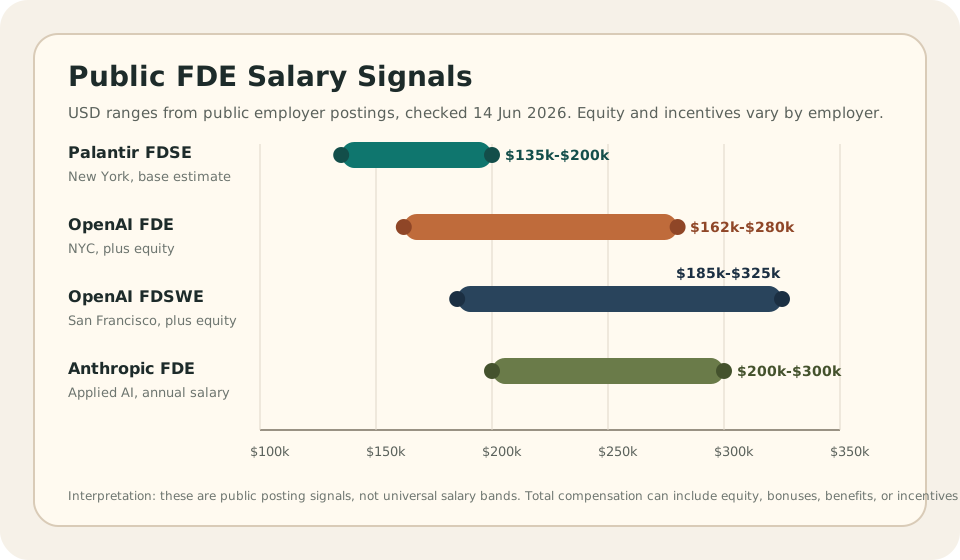
Public employer postings checked on 14 June 2026 show that FDE-related roles in the United States can sit from the mid-$100k base-salary range into the low-$300k salary range, with equity or long-term incentives sometimes offered separately.
These numbers are not universal pay bands. They are point-in-time signals from public postings, and they mostly reflect senior, customer-facing, AI or data-heavy engineering roles in expensive US technology markets.
| Public role signal | Posted compensation signal | What the range is pricing |
|---|---|---|
| Palantir Forward Deployed Software Engineer | USD 135k-200k estimated salary, with possible restricted stock, sign-on bonus, and future incentives excluded from the base estimate | Customer-side delivery, business-critical data, AI-assisted operations, custom applications, stakeholder engagement, and project ownership from ideation to deployment. |
| OpenAI Forward Deployed Engineer, NYC | USD 162k-280k plus equity | End-to-end frontier-model deployments, discovery, technical scoping, system design, production rollout, adoption measurement, eval-driven feedback, and field input into product and model roadmaps. |
| OpenAI Forward Deployed Software Engineer, San Francisco | USD 185k-325k plus equity | Deep customer embedding, full-stack solution design, project plans for prototypes and production deployments, hands-on customer infrastructure work, and codified delivery patterns. |
| Anthropic Forward Deployed Engineer, Applied AI | USD 200k-300k annual salary | Production applications using Claude models, MCP servers, sub-agents, agent skills, enterprise deployment support, repeatable AI deployment patterns, and frontier AI implementation judgment. |
The pattern is clear: the market does not price the title alone. It prices the combination of customer ambiguity, production software, AI deployment, data judgment, delivery pressure, and product feedback. A role that only configures software or writes advisory documents should not be compared directly with roles that own production systems inside strategic customer environments.
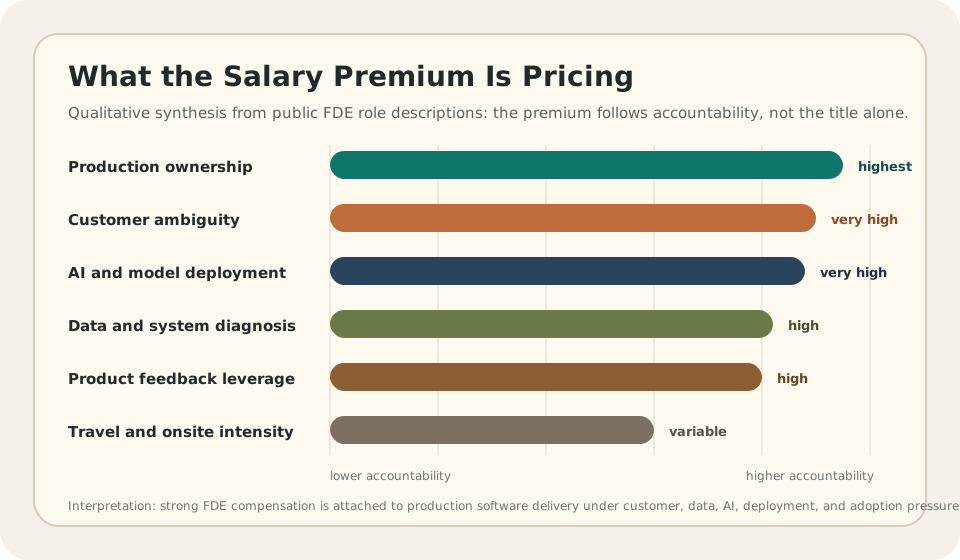
This is why salary research needs the job description beside the number. A USD 300k range is not evidence that every FDE role pays like a senior AI platform engineer.
It is evidence that some employers attach senior-engineer compensation to roles where the FDE is expected to ship production software, handle deployment ambiguity, work directly with customers, and convert field learning into reusable product capability.
What good FDE work looks like
Good FDE work has concrete signs.
The business problem is expressed as a decision or workflow change, not a tool request.
The data assumptions are written down, tested, and exposed where they affect trust.
The software path is small enough to ship but strong enough to maintain.
The deployment plan includes permissions, secrets, logs, metrics, rollback, and support ownership.
The user can explain when to trust the system and when not to trust it.
The field learning produces reusable product, platform, or delivery knowledge.
What bad FDE work looks like
Bad FDE work often looks fast at the beginning and expensive later.
Common failure modes include:
- building against the stakeholder's first request instead of the real operating decision
- trusting sample data that does not match production reality
- shipping a brittle custom script with no owner, tests, logs, or monitoring
- hiding data uncertainty behind a confident interface
- ignoring permissions, lineage, compliance, or support burden
- creating customer-specific branches that cannot be maintained
- treating deployment as someone else's problem
- failing to turn repeated field patterns into product learning
The role is not about heroic one-off delivery. It is about speed with enough engineering discipline to avoid leaving hidden operational debt behind.
How the job differs from nearby roles
A business analyst may define the process but stop before implementation.
A data scientist may build a model but stop before production integration.
A software engineer may ship clean code while staying away from the real customer workflow.
A solutions engineer may design, configure, or validate a solution but may not own the full production path after launch.
A consultant may frame the problem and help deliver the project but may leave before the system proves itself under live use.
The FDE job differs because it keeps accountability across the boundary. The same role stays close to the decision, the data, the code, the deployment, the user, and the production consequence.
The dedicated FDE comparison guide separates this role from full-stack engineering, software engineering, solutions engineering, customer engineering, implementation engineering, solutions architecture, AI engineering, and consulting.
A concrete example
Take a warehouse forecasting problem.
The visible request may be simple: forecast demand so the operation can allocate labor and transport capacity. The FDE job begins when that request is turned into a production requirement: predict which site, shift, and capacity constraint requires action before the staffing plan is locked.
That requirement exposes the real engineering work. Historical demand may arrive late. Sites may use inconsistent SKU mappings. Promotions may be corrected manually outside the primary system. Shift planners may trust some fields and ignore others. Dispatch teams may rely on a workaround that the ERP does not represent.
The FDE has to test the source data, define fallback behavior, choose the forecasting path, expose the output where planners act, deploy the system with the right permissions, monitor forecast error and usage, and watch whether planners override or trust the result.
The deliverable is not the model. The deliverable is a production decision system that improves planning without creating a support burden.
The practical test for the job
The practical test is whether the same piece of work connects these layers:
- the business decision that needs to improve
- the workflow people actually follow
- the data assumptions and failure modes
- the software path that carries the logic
- the deployment environment where it runs
- the production signals that show whether it is trusted
- the owner who is accountable after launch
- the product learning that should be reused
If those layers are disconnected, the work may still be useful, but it is not full forward deployment engineering.
That is the job of a forward deployment engineer: convert ambiguity into a production system, keep ownership across the boundary, and make the field work compound into better product capability.
For the broader FAQ version of the topic, return to Forward Deployment Engineering.